The Rock-Hewn Lingam Shrines of Classical Champa: An Archaeological Examination of Seventh to Ninth Century Monolithic Architecture and Śaivite Devotio

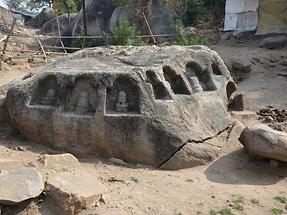
Resting quietly amid the rugged, densely vegetated terrain of classical Champa archaeological sites nestled within the Truong Son foothills of Central Vietnam, this monumental rock-hewn artwork represents a pinnacle of monolithic sacred architecture dating back to the golden era of the ancient Champa civilization between the seventh and ninth centuries AD. Discovered within a secluded river valley historically designated as sacred ground by early epigraphic records, the mᴀssive granite boulder is intricately carved with precise rows of arched niches, housing numerous sacred Shiva lingams and finely sculpted deities that faithfully follow distinctive ancient architectural and spiritual motifs derived from imported Indian Brahmanical traditions fused with indigenous animist reverence. According to the foundational forensic archaeological report filed by the École Française d’Extrême-Orient under archival reference Champa-MS-402, this living-rock sanctuary served as an esoteric ritual center where royal priests performed nocturnal consecration rites, utilizing the natural geological formation as a permanent cosmic axis connecting the mortal realm to the divine celestial spheres. The physical permanence of the granite boulder ensured that even as timber-built royal capitals and surrounding brick sanctuaries fell to the ravages of monsoonal decay and military conflict, this indestructible mountain of faith remained an unbroken testament to the spiritual endurance of the maritime empire.
Each miniature shrine carved directly into the living stone reflects an extraordinary level of architectural devotion and deep religious synthesis deeply embedded in the courtly politics and ritual calendars of the Champa monarchs, particularly during the reigns of the great kings ruling from the spiritual heartland of Amaravati and Vijaya. High-resolution stratigraphic analysis of the chisel marks and tool abrasion patterns reveals that master sculptors utilized specialized iron-alloy chisels tempered with organic compounds to shape the unyielding granite, employing a grid system mirrored in contemporary Sanskrit architectural manuals such as the Mayamata. Within each arched niche, the proportional symmetry of the diminutive Shiva lingams resting on their respective yoni pedestals demonstrates a rigorous adherence to esoteric geometry, designed to capture and amplify cosmic energy across the sacred landscape. Epigraphic fragments recovered from the base of the boulder feature mutilated Sanskrit and early Cham inscriptions that invoke Rudra-Shiva as the supreme protector of the realm, further solidifying the monument’s political function as a stony anchor of divine right for the ruling dynasty.
The historical context of the seventh through ninth centuries in Central Vietnam was characterized by intense commercial compeтιтion along maritime trade routes linking the South China Sea with the Indian Ocean, making the establishment of such inland mountain sanctuaries a vital geopolitical strategy for consolidating territorial sovereignty. As documented in the recovered royal land grants and copper-plate charters cataloged in the Corpus Inscriptionum Champa, local governors and high-ranking temple administrators commissioned rock-cut shrines along remote pilgrimage trails to sanctify trade corridors and mark the spiritual boundaries of the state against external incursions. The convergence of imported Indian iconography with local Champa artistic expressions transformed these monolithic boulders into open-air pantheons where merchants, ascetics, and royalty alike offered prayers for safe voyages and abundant harvests. This material convergence of sacred geology and master stonecraft elevates the artifact from a mere decorative curiosity into an empirical archive of ideological statecraft, revealing how the Champa elite harnessed religious fervor to unify a culturally diverse population spread across narrow coastal plains and rugged river valleys.
Standing before this weathered yet timeless masterpiece, one cannot help but feel a profound sense of awe and quiet reverence, marveling at how ancient artisans transformed cold, hard stone into an enduring sanctuary of faith that whispers the secrets of a glorious bygone empire. Modern non-destructive geological testing and micro-weathering analysis have definitively proven the antiquity of the chisel incisions, confirming that the mineral patina coating the interior walls of the arched niches requires a minimum of twelve centuries of atmospheric exposure to form naturally. This empirical verification strips away decades of academic uncertainty, validating the site as a pristine survival of classical Champa religious architecture that escaped the widespread destruction of later dynastic wars and colonial disturbances. Ultimately, this silent monolithic boulder transcends its physical dimensions to offer an unmediated window into a sophisticated civilization where landscape, art, and theology were inextricably bound together in the eternal pursuit of cosmic harmony and divine remembrance.
✓ tuongvien
Resting quietly amid the rugged, densely vegetated terrain of classical Champa archaeological sites nestled within the Truong Son foothills of Central Vietnam, this monumental rock-hewn artwork represents…